
Needleless Injections During Egg Donation
For years, the word “injection” has made many potential egg donors hesitate before they even pick up the phone. The idea of weeks of daily hormone shots is enough to put off women who would otherwise love to help someone build a family. But fertility medicine has quietly been solving this exact problem — and needleless injection technology is one of the most promising advances to come out of it.
If you’re researching donation and wondering whether the process has to involve needles at all, or if you’re simply comparing your options at an egg donation centre in Delhi, this guide breaks down how needle-free technology actually works, what it means for comfort and safety, and what to expect from a modern donation cycle.
Why Needles Have Always Been Part of Egg Donation
Egg donation relies on a process called controlled ovarian stimulation. Donors receive hormone medications — usually gonadotropins — for about 8 to 12 days to encourage the ovaries to mature multiple eggs instead of the single egg released in a natural cycle.
Traditionally, this has meant:
- Daily subcutaneous injections, often self-administered at home
- A final “trigger shot” to prepare the eggs for retrieval
- Mild bruising, skin irritation, or anxiety around needles for many donors
None of this is unbearable, but it is a genuine barrier. Needle phobia (medically known as trypanophobia) affects a meaningful share of the population, and even donors without a fear of needles often find the daily routine tedious or uncomfortable.
What Is Needleless Injection Technology?
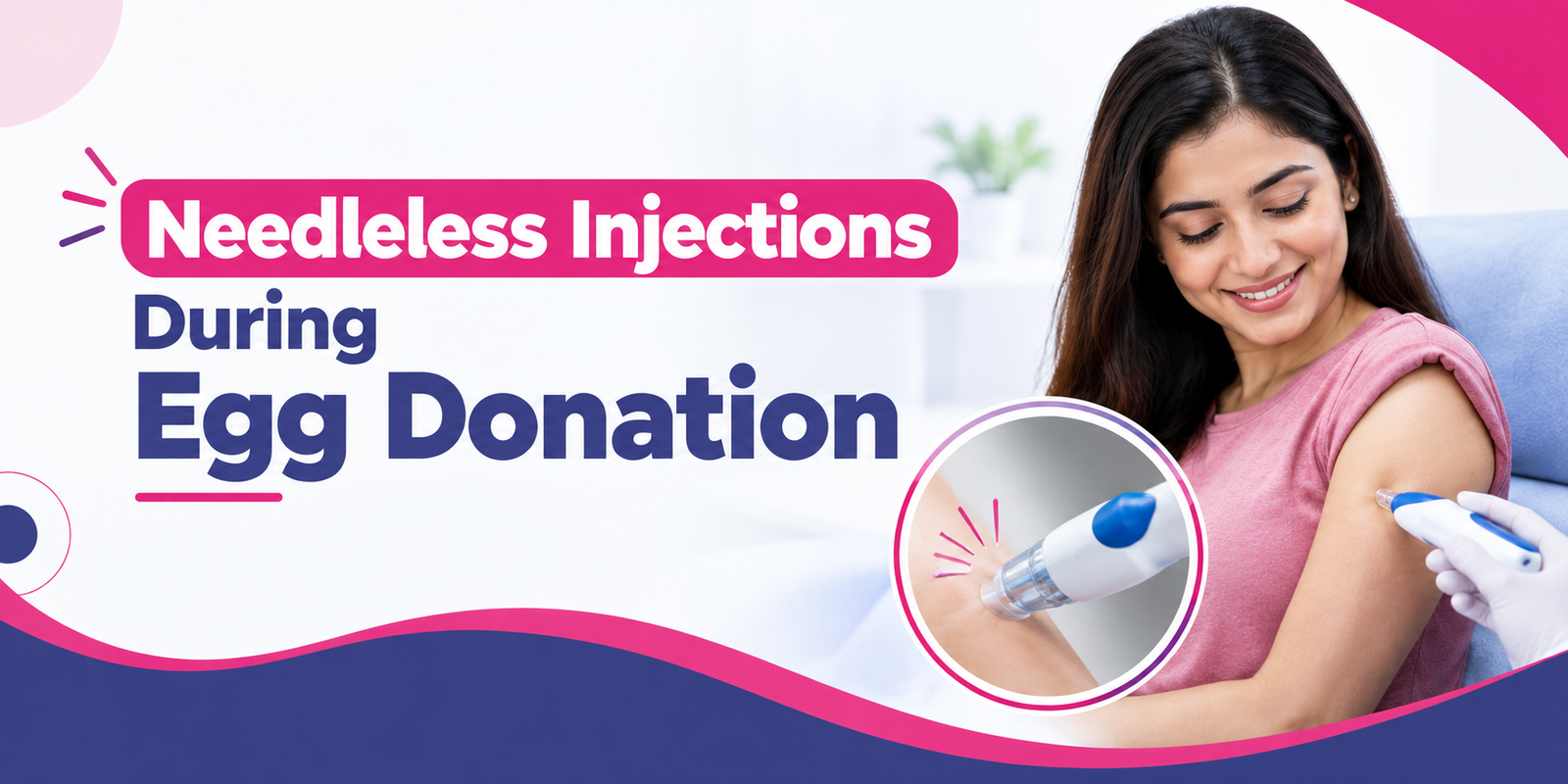
Needleless — or needle-free — injection technology delivers medication through the skin without a traditional needle puncture. Instead of a needle carrying the drug into subcutaneous tissue, these systems use alternative delivery mechanisms.
How the Technology Works
There are two main approaches currently used or studied in fertility care:
1. Jet injection devices. These devices use a narrow, high-pressure stream of medication — propelled by compressed gas or a spring mechanism — to push the drug through the skin in a fraction of a second. One early example, the J-Tip device, used compressed carbon dioxide to propel fertility hormones through the skin and was shown to be well tolerated during IVF stimulation cycles. No needle ever touches the skin; the pressure alone creates a temporary micro-channel for the medication to pass through.
2. Wearable catheter-based systems: A newer approach involves a small, adhesive patch placed on the abdomen — similar in size and feel to a continuous glucose monitor. This patch contains a flexible port just a few millimeters long that sits under the skin, and medications are administered through it via a twist-on syringe connection rather than a fresh needle stick each time. The port is inserted once and can remain in place for the full stimulation window, typically around 9 to 12 days, before being replaced if needed.
Both approaches share the same goal: eliminating the need to pierce the skin with a needle for every single dose.
Why It Matters for Egg Donors
This kind of technology is designed to eliminate the discomfort and stress that many people associate with daily hormone injections during fertility treatment, offering a more comfortable and user-friendly alternative.For egg donors specifically, this can translate into:
- Less anxiety in the days leading up to and during stimulation
- Fewer skin reactions from repeated needle sticks in the same area
- A smoother, less clinical daily routine, especially for first-time donors
- Greater willingness among needle-averse women to consider donation at all
Is Needle-Free Technology Widely Available Yet?
It’s worth being transparent: needle-free and needle-reduced injection systems are still an emerging technology in fertility care, not yet a universal standard at every clinic. Early clinical presentations on jet-injection systems for IVF stimulation date back over two decades, and newer wearable patch systems have only been introduced at select fertility centres in recent years.
That means the availability of this technology can vary significantly depending on where you choose to donate. This is exactly why the reputation and technological readiness of your chosen clinic matter as much as the science itself.
What to Look for in an Egg Donation Centre in Delhi
If comfort and modern technology are priorities for you, here’s what to check before committing to a donation cycle:
- Ask directly about injection options. A reputable egg donation centre in Delhi should be able to tell you clearly whether needle-free or needle-reduced systems are available, or whether standard subcutaneous injections will be used.
- Check donor support infrastructure. Good clinics offer hands-on training for self-injection, nursing support, and a clear explanation of side effects — regardless of which delivery method is used.
- Review the clinic’s safety protocols. Whether needle-based or needle-free, medication handling, storage, and administration should follow strict clinical standards.
- Understand the full stimulation timeline. A trustworthy clinic will walk you through the entire process — from initial screening to trigger shot to egg retrieval — not just the injection portion.
- Look at donor experience and outcomes. Ask how many donation cycles the centre has managed and what kind of ongoing monitoring donors receive.
Common Questions About Needle-Free Egg Donation
Does needle-free mean pain-free? Not entirely. Jet injection can cause a brief stinging or pressure sensation, and wearable ports involve a single, minimal skin insertion. However, most donors report significantly less discomfort than repeated daily needle sticks.
Are the hormone doses different with needle-free systems? The medications themselves — typically recombinant FSH and GnRH antagonists — remain the same. What changes is the delivery method, not the drug protocol, which continues to be determined by your fertility specialist based on your individual response.
Is needle-free injection as effective as traditional injections? Available research on needle-free hormone delivery for ovarian stimulation has shown comparable outcomes in terms of follicle development and egg retrieval when the device is used correctly, though larger-scale, long-term studies are still ongoing.
Will every fertility clinic offer this? No. Since this is an evolving technology, it’s important to ask your chosen clinic directly rather than assume it’s standard.
The Bigger Picture: Technology Making Donation More Accessible
Needle-free injection systems are part of a broader shift in reproductive medicine toward reducing physical and psychological barriers for donors and patients alike. As more clinics adopt wearable delivery systems and refined jet-injection technology, the day-to-day experience of egg donation is becoming noticeably gentler than it was even a decade ago.
For anyone considering donation, this evolving technology is a good reason to have an open conversation with your fertility team about what modern options exist — and to choose a clinic that’s transparent about the tools it uses.
Final Thoughts
Needleless injection technology won’t remove every needle from the fertility journey just yet — trigger shots and blood draws are still typically part of the process — but it represents real progress toward making egg donation more comfortable and less intimidating.
If you’re exploring your options, take the time to ask detailed questions about injection methods, monitoring, and support before choosing where to donate. A well-established egg donation centre in Delhi that stays current with fertility innovations can make the entire experience smoother, safer, and far less stressful than you might expect. Reach out to a trusted clinic today to discuss which injection approach is right for you and take the next step toward a comfortable, well-supported donation journey.